


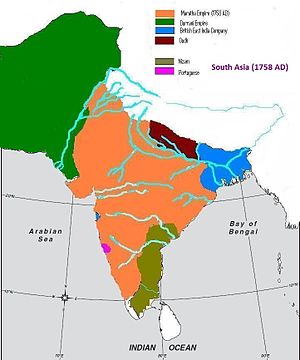
[ Dark Green – Durrani Empire; Orange – Maratha Empire; Brown – Oudh]
[Blue – British East India Company; Dirty Green -Nizam; Pink – Portuguese]
Rummaging through the internet, an idle pursuit that has grabbed me the last few years, I suddenly came across this map in the Wikipedia under the Third Battle of Panipat. It may be recalled that The Marathas lost the Third Battle of Panipat in 1761 to the Afghan ruler Ahmad Shah Abdali of the Durrani clan. It put a damper to the Marathas’ onward march for a pan-Indian empire and their conquests extending into Afghanistan. The Maratha empire lived on for several decades as the premier power in the subcontinent before their defeats in the hands of the British in the Second and Third Anglo-Maratha Wars (1815-1818). In the words of the Indian historian Sanjeev Sanyal, “British did not gain supremacy from the Mughals but from the Marathas”.
We have all grown up with the tales of Chhatrapati Shivaji and his epic battles with the mighty Mughal emperor Aurungzeb and his dream of establishing a pan-Hindu empire. We have also heard of the exploits of Baji Rao and other Marathas. Nevertheless, I found the large swathe of India under Maratha control before the Battle of Panipat really impressive, if not mind boggling. And there is more. The little ‘blue’ piece carved out by the British came to them on a silver platter after their victory in the Battle of Plassey. Historical evidence shows the Plassey victory in 1757 was more a result of treachery of Mir Jafar, the minister in chief of the young monarch, Siraj-ud-daula, and a conspiracy between the powerful noblemen, most prominently Jagat Seth, a Marwari and the chief financier of the empire and a high ranking Bengali nobleman, Raj Ballabh. Siraj had only ascended the throne less than a year upon the death of his grandfather Allivardi Khan. Allivardi’s empire was ravaged by constant raids by the Marathas under Raghuji Bhonsle; his coffers were depleted and his empire greatly weakened. He gave up his control of Orissa to the Marathas. Similar, I believe was the situation in Nizam’s Hyderabad (the dirty green piece in the map) and the kingdom of Oudh (brown in the map). The areas were under constant siege by the Marathas.
Makes one wonder what the world may have become if only a little something – not a whole lot – had gone the other way. The Imperial British Empire, ‘where the sun never set’ may never have quite risen in the first place. After all, British colonizing ambitions were sprouted and nurtured by their conquests in India. Before the Battle of Plassey, perhaps the only British colony of consequence was the 13 colonies of America, which soon broke with the empire in 1776.
And what of India? Perhaps this is a more interesting question. Would India’s development been stunted without the British hegemony? Recent research by Madhushree Mukherjee and others have brought to our attention the destruction to Indian economy including the high incidence of famines during the British rule. (Dadabhai Naoroji, the grand old man of Indian politics pointed out the drainage of resources from India over 150 years ago). By the same token, the Marathas of later years were no saints. The adorable Marathas under Shivaji and Baji Rao had degenerated into fearsome marauders and pillagers. The menace of the Maratha (Bargi) attacks still lives on in Bengali lore and in the Maharashtra Purana written in Bengali just before the advent of the British empire. A similar composition in Oriya in the eighteenth century, Samarataranga, a poem about war and chivalry, also has the Oriya Maratha conflict as the context. There are indications, apparently quite reliable, that in 1791, Maratha forces under Raghunath Patwarddhan attacked the famous Shankaracharya Math in Sringeri during their attack on Bednur. The Marathas indulged in plundering the temple and caused considerable damage to it. The damages were later repaired, reportedly with the help of Tipu Sultan. There are also reports of possible Maratha attacks on the famous Tirupati temple in 1759 by the Maratha general Gopal Rao. They demonstrate for us that temple destruction may not be a monopoly of the Muslim invaders as we have generally been led to believe.
But then again, perhaps conquerors in the real world are never saints, though they may sometimes be made to appear as such in later years.
EPILOGUE
Ten years or so after their defeat in the Battle of Panipat, the current Peshwa, Madhavrao. divided the Maratha empire into a loose federation reminiscent of the Greeks after the death Alexander the Great when the empire was among his generals. and the after the death of Chengiz Khan, his Mongol empire, the largest empire till the British came along, among his four sons. The major successors were the generals of the Maratha Army: Gaekwad (Baroda in Gujarat), Peshwa (Maharashtra), Scindia (Gwalior in Madhya Pradesh) Holkar (in Indore), and Bhonsales (in Nagpur). With the establishment of British hegemony, they became some of the major Princely States under the British Indian Empire. Some played important roles in history, including the Sepoy Mutiny. Rani Laxmibai was the queen of the Maratha kingdom in Jhansi in southern Uttar Pradesh. The effect of the extent of Maratha conquests are well reflected in the wide distribution of the states. Baroda and Gwalior were particularly progressive states: Sri Aurobindo was an administrator in Baroda before giving up his post to become a revolutionary. The Scindias are still prominent in Indian politics. Finally, I would be remiss if I did not mention Queen Ahalyabai of Holkar (1725 – 1795). She was a principal financier for the rebuilding of many temples of the destroyed by the Muslim rulers, most prominently the Vishwanath temple in Varanasi and the Temple in Mathura.
“This article is reprinted with permission from Ananda Sangbad, January 2021 issue”.





Comments »
No comments yet.
RSS feed for comments on this post. TrackBack URL
Leave a comment