


Click below to read and print as pdf file
Jagadananda1
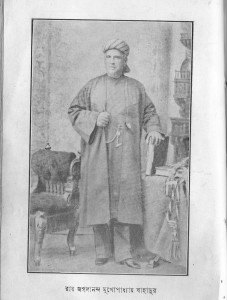
Born: November 27, 1821
Died: November 17, 1892
I left India after marriage in 1971 to come to USA. My sons are Shubhabrata Chaudhuri, Soumyabrata Chaudhuri, and Shankha Brata Chaudhuri. They are all well placed in the technology area in USA. I am writing this mostly for my children and the next generation.
The above picture portrays my Father’s great-grandfather, a true visionary. Calcutta High Court Lawyer.
Jagadananda Mukhopadhyay was born to a very renowned Hindu Brahmin family in the town of Moynapur, about 10 miles away from the city of Bisnupur, district of Nadia in West Bengal, India. Once, Bisnupur was the capital of Bengal around 785 AD during the reign of Dharmapal. The name of this place was mentioned in the book of “Dharmangal”. This place has a very long history of glory, wealth as well as discipline maintained by its rulers.
In the seventeenth century when Nawab Murshidkuli Khan was the ruler of Bengal, he settled in Murshidabad making it the capital of Bengal. The whole state of Bengal was divided into several parts and was under the rule of Nawab Mushidkuli Khan. Bisnupur stayed as an autonomous body of his domain, it was the primary residence of his prime minister. The Maharaja of Bisnupur was acknowledged as an excellent ruler, he had to pay a little bit of tax to the Nawab but enjoyed autonomous power to rule Bisnupur.
The last ruler of Bisnupur was Maharaja Krishnachandra Roy. In 1730 Naikashya Kulin Nidhikrishna Mukhopadhyay, an extremely religious Bramhin married the sister of Krishnachandra Roy and started living in Moynapur, a part of Krishnachandra’s territory. One part of Moynapur was named Dewanpara (the home of the ministers). Nidhikrishna Mukhopadhyay settled in that area.
Chandicharan Mukhopadhyay was the oldest grandson of Nidhikrishna Mukhopadhyay, the youngest grandson’s name was Padmalochan.
After Nidhikrishna’s death, Chandicharan became dewan(minister). Chandicharan was not only a devoted, loyal and, intelligent minister but was very religious also. He firmly believed in human compassion as well. The family of Dewan Chandicharan was called the great Nanda Family of Bisnupur. Historian Dr. Walsh, IMS, civil surgeon wrote in his book on the history of Murshidabad, West Bengal, “The family is well known to the Government for their loyalty and devotion and acquired high position in society for their humanitarian work to the public. For this reason, they were generally called the ‘Great Nund Family of Bengal’.
Chandicharan Mukhopadhyay
During the reign of Maharaja Krishnachandra Roy, Nidhikrishna passed away and his heir Chandicharan was appointed as the dewan(chief minister) of the state. During this period the British army defeated Nawab Siraj-Ud-Daulah and appointed Mir Jafar as the head of the state. Lord Clive and his associate Warren Hastings attacked Bishnupur, dewan Chandicharan was caught by the British army and was imprisoned.
The legend about his freedom says that Chandicharan started a hunger strike and was deeply involved in meditation. He took the oath to end his life. He was an extremely religious person, a devotee of Lord Krishna, and also very loyal to Maharaja Krishnachandra Roy. One Sheik soldier of the British army had a dream that the army would be destroyed by the outbreak of disease since Dewan Chandicharan was locked up in jail and it was a sin. When the soldier’s dream came true and lots and lots of British soldiers were affected by the disease the British army was convinced by that Shikh soldier’s dream and released Chandicharan from the prison and then made peace with the Maharaja.
Chandicharan was reinstated to his former position and received great honor from the Maharaja. As a religious and righteous person was he so was his wife. She ran a charity for poor people, everybody always used to praise them. Chandicharan received Lord Krishna’s statue from the temple, he put the statue in his altar. It was stolen three times but was recovered. The general public believed that the Mukhopadhyay family became prosperous because of the grace and the blessings of Lord Krishna.
He was such a pious man that he asked that he be taken by the Ganges river when he realized that his life was coming to an end. His body was brought by the river bank and he started quoting the Hymns from the Bhagavad Gita until he took his last breath.
The will to uplift the status of his own family as well as help the poor and needy families were his goals which he established not for himself only but for posterity as well.
Kaliprasad Mukhopadhyay
Chandicharan’s two sons Kaliprasad and Tariniprasad were only eleven and nine years old when Chandicharan passed away. Chandicharan made a will that his property will be divided equally among the four boys of his family, his two sons Kaliprasad, and Tariniprasad and his brother Padmalochan’s boys Sharadaprasad and Annadaprasad. Such an honest and family-oriented person was very rare at any time in history.
After Chandicharan died his older son Kaliprasad became a dewan(minister) on time but he decided that he would rather live in Benaras by the river bank living a life like a saint and asked his younger brother to take over the responsibility of the minister. He had eight sons and two daughters, their names were Purnananda, Kuladananda, Tarananda, Rameshananda, Umeshananda, Maheshananda, Shrishananda, Shailajananda and the girls were Gyanadanandini, and, Suronandini. All of them were highly educated and well-established in their lives.
Dewan Tariniprasad
When Kaliprasad decided to go to Varanasi (Benaras) to live the life of a saint, his younger brother Tariniprasad took over the responsibility of the dewan(minister) of Bishnupur. During this period Lord Cornwallis introduced the settlement with the zamindars of Bengal.
Tariniprasad received one-fourth of his father’s property which was a tremendous amount but he didn’t sit idle doing anything. He learned many languages including Arbi and Farsi which were not easy to learn. Because of his qualities and hard-to-find people similar to his intellect he was appointed by Sir Frederick Halliday (the first viceroy of Bengal) to be the collector of the whole district of Burdwan. Then he was also assigned to be the collector of the district of Bankura as well. He worked until a very late age and deceased at the age of seventy-nine.
Like everybody in the Mukhopadhyay family, Tariniprasad was also a very pious and righteous person. He built the enormous Haveli (palace-like house) where not only his family lived but many members close or not so close to the family lived and enjoyed their lives at his expense.
He built a big lake or reservoir for the entire community to use for their daily use of water. His name is still remembered in Moynapur, Bankura district, West Bengal India. “Toye putre naranang punyalakhnank” (তোয়ে পুত্রে নরানাং পুন্যলক্ষনং) was his primary concern meaning your children’s qualities are the best and humane.
Jagadananda Mukhopadhyay
Jagadananda was born on the 27th of November, 1821 (13th Agrahayan, 1228 Tuesday according to the Bengali calendar) at Tariniprasad’s house at Sheuri. He was the firstborn his mother’s name was Govindamoni. Later Tariniprasad had six sons and three daughters. Their names were Shymalananda, Shibananda, Gangananda, Bhairabananda, Bimalananda, Bagalananda, Shashikopolini, Bidhukopolini, and Dakshinakopolini.
Jagadananda’s primary education was done in the missionary school and then he went to Hoogly for his formal education. After finishing high school he went to college and studied law. In 1837 he was married to Mathangidevi, daughter of Ganganarayan Roy. Mukhopadhyay or the Nanda family had a matrimonial connection with the great Roy family on at least twelve occasions.
He studied law like many members of his family and started his career as a junior pleader, later he was appointed as the government pleader in the Calcutta Supreme Court (it was the Supreme Court of India at that time) in 1851. He moved to Bhowanipore, Calcutta with his family. Bhowanipore was not a livable place at that time. It was like a jungle, full of big trees, bushes, and, wild animals.
Jagadananda, being born into a wealthy family had an inherent taste of creating a healthy and beautiful environment so he engaged workers to clean the surrounding area and planted flower gardens. Those flowers were Jasmine, Tuberose, Sunflower, Roses, Rhododendron, Marigold and many other flowers. Out of all of these, the Jasmine trees were planted along the roadside of Bhowanipore, which is why the area is still called Bakulbagan(the garden of Bakul or Jasmine flower).
As his law career started booming his name as a government pleader was getting familiarized in the Supreme Court of Calcutta and to the British rulers as well. During this period as India was under British rule, the leaders of many socialistic organizations were being held by the British government in jail. He was a very humanitarian lawyer, all the native political criminals that he was assigned to deal with he made sure they got less punishment than it would have been had there been a British lawyer assigned to these cases. As his fame was increasing at the government level, he incurred the anger of many native people because of his ability to move above the norm and his liberal view towards women because he took an oath to emancipate them from the terrible bondage of unrealistic strict social rules and rituals.
VISIONARY JAGADANANDA MUKHERJEE
On 22nd December, 1875 the Prince of Wales (who became Emperor Edward VII) came to Diamond Harbor on an India tour by the ship named ‘Serapin’, from there he came to Calcutta. Sir Richard Temple welcomed him at the Princep Ghat where Viceroy Lord Northbrooke and many other renowned people came to welcome him. The city of Calcutta was decorated nicely to welcome the Prince since this was the first visit by the royal family of the then-ruler England.
The good luck of Jagadananda was at its peak. His name was well known at the government level. He was extremely successful in his law business. On the 3rd of January 1876, the prince came to visit Jagadananda in his palace-like house at Bakulbagan, Bhowanipore, Calcutta. Major Walsh, I.M.S wrote about him in his book on the history of Murshidabad (1902) “His eventful life was brought into prominence both abroad and in India by the auspicious visit paid to him in his private residence by the present King-Emperor Edward VII (Prince of Wales) in his Indian tour of 1875.”
From the diary of Jagadananda, it was excerpted:
3rd January, 1876
2nd Pous, 1282, Monday
My second daughter Khiroda gave birth to her second son at 8:00. Mr. Hogg came to see me in the evening. Mr. Hogg was knighted by the Prince of Wales. The Prince of Wales came to my house at 3:30 p.m. Miss Barnets, Lady Temple, Lady Malet, Lady Hogg, and Miss Milman also came. Sir Richard Garthe, Chief Justice brought with him Mrs. Mengles, we made present to the Prince:-
One emerald necklace.
One pair of gold bangles.
One gold neck chain.
One pair of Dacca embroidery Muslin for Rs.1600.
One plain Dacca Muslin for Rs. 250.
One pair of embroidery Benares mad Than Rs.300.
4 bottles of rose water each bottle Rs.30.
One pair of slippers made by my daughter-in-law.
3 cotton malas.
The prince was very much pleased. The prince left Calcutta at 9 pm.
With the permission of the Prince his private secretary wrote about the Prince’s trip to India in his book which was published in 1877. He wrote about the Prince’s trip to Jagadananda’s house in Bhownipore:
3rd January, 1876
“How it came about I do not know exactly but it is probable the Prince expressed a wish to see the Zenana(ladies) of some respected native and that the wish was made to the worthy Hindoo of Bhowanipore. Mr. Mukherjee was too happy to gratify it today. Miss Baring, Lady Temple, Miss Milmen, Lady Stuart Hogg and others had perhaps some part in this pour parlers. There were hundreds of children assembled to see the Prince arrive; most of the little ladies held pretty bouquets with which out of local devotion to pelt the Prince. These children may develop into Hindoo Blooms and establish women’s Rights associations unless their wild shrieks of liberty are silenced into the laden flood of caste and custom that has drowned so much thought of life in India century after century. Instead of salutes and flourishes or bell peeling the Hindoos use conches to announce the arrival of guests; the noise of these natural horns makes one rejoice that he is not among the Tritons. These were sounded often and long for there were false alarms of the Prince coming but at last his carriage came in sight and there was conch-blowing –His Royal Highness did not appear in the splendid attire which Mrs. Mukherjee and her fair friends no doubt thought a Prince should wear. Whether Babu Jagadananda Mukherjee will ever get over the wrath of his co-religionists for the doing of this daytime time only be shown. There is one fact revealed by how the occurrence was accepted by those concerned. Hindoo ladies at all events do not consider strict seclusion at all essential to their happiness. But it is dangerous to argue from a Particular to the Universal and so it will be safer perhaps to say that some Hindoo ladies do not dislike being seen at all events by a Prince of Wales.(W.H Russ, Honorary Secretary to the H.R.H. Prince of Wales and a member of the Prince’s suite accompanying him to India”).
This being said by Mr. Russell, it was documented that Jagadananda was in favor of women’s independence and education but the then so-called elite society could not accept his guts so they wrote nasty poems about him, ridiculing him in many ways and even wrote a drama about it and made performances publicly.
“In 1876, the Dramatic Performance Act was implemented by the British Raj to police seditious Indian theatre. After the visit of the Prince of Wales at Jagadananda’s house the Great National Theatre presented a play that sought to target Jagadananda Mukherjee, a well-known citizen of Calcutta, junior government pleader, and member of the Bengal Legislative Council. This man had invited the Prince to his Bhowanipore residence on January 3rd, 1876, and had taken him on a tour of the ladies’ apartments of the house where he was given a traditional Bengali welcome by the female members of the family. This incident enraged the orthodox Bengali society for it appeared to them that Jagadananda had sacrificed his ethics and culture in a bid to placate the British masters and win favors from them. The satirical play based on this incident in which Jagadananda was victimized was stopped by police order.”
Since Jagadananda was a true visionary, what he envisioned about the liberalization of women did come true later. Education and freedom from social bondage were his primary criteria for women which was not realized by the orthodox Bengali society as much so the mockery of his character as I see it now was not only prejudiced but in one way an exposure of jealousy as well. No matter what, his accomplishment was recognized by many although the heights of the society that he was able to move to were not attainable by many even from his own family because he was one and only, his name has been a legend to the posterity.
WHERE AM I?
Jagadananda’s second son Shyamakumud(a magistrate of Hooghly district) had three sons, Jyotiprasad, Shibaprasad, and Anadiprasad. Shibaprsad was my grandfather, and my father Pankajananda Mukhopadhyay was his youngest son.
As I am planning to write a book on Jagadananda I am inviting anybody that is related to this family to contact me through the feedback section of the website and I will appreciate it.
Bibliography:
1. The personal diary of Jagadananda Mukhopadhyay compiled by Chandrashekhar Mukhopadhyay.
2. WIKIPEDIA link — https://en.wikipedia.org/wiki/Maynapur









Comments »
No comments yet.
RSS feed for comments on this post. TrackBack URL
Leave a comment