


Is the Pervasive Impression of a Tyrannical Despotic Proselytizing Muslim Rule in India the Result of an Orchestrated British Construct? – A Layman’s Query
Author: Partha Sircar
Recent pronouncements by Shashi Tharoor, Madhushree Mukherjee and others regarding the British Rule in India have severely shaken the entrenched beliefs among many of us regarding the benevolent British who propelled us to a progressive new world by pulling us out of the morass left by the Muslim rulers that preceded them. Tharoor has shown convincingly in the lectures he delivered in Oxford and other places and in several books he has written recently, that India’s economy dropped down from 25 percent of its share in the world economy during the inception of British hegemony to a mere 3 percent when we were granted independence, firmly establishing us as a poor nation. Mukherjee has called out loudly the vile machinations of Winston Churchill and the complicity of British policies which led to the horrendous Bengal famine of 1942. The occurrence of several other major famines during the British period, some even bigger than the Bengal famine are on record, the likes of which are not evident before or since. The obvious conclusions from the above assertions would indicate that the British destabilized and destroyed the country they conquered from the erstwhile Muslim rulers. I, therefore, keep wondering: if there is a serious disconnect between the popular image of progressive benevolent British succeeding an antiquated barbaric Muslim hegemony and the image of British India shown by Tharoor, Mukherjee and others.
I wonder if this ‘disconnect’ also raises the question of a similar ‘disconnect’ regarding the preceding Muslim rule. There is the popular knowledge that Muslim rulers were cruel despots, indiscriminately killing, raping women and forcibly converting by the thousands. The highly regarded historian Will Durant in his Story of Civilization reflects the typical view – “The Mohammedan conquest of India is probably the bloodiest story in history. The Islamic historians and scholars have recorded with great glee and pride the slaughters of Hindus, forced conversions, abduction of Hindu women and children to slave markets and the destruction of temples carried out by the warriors of Islam during 800 AD to 1700 AD. Millions of Hindus were converted to Islam by sword during this period.” Similar sentiments are betrayed by other historians during the British period and by subsequent historians. But I find little solid evidence to reinforce this dismal image of the Muslim Rule – that, as Tharoor notes, controlled 25 percent of the world economy, only to be ruined in subsequent years by the British conquest. Even the very popular story narrated by James Tod in his well known book on Rajput history, that of Rani Padmini (Padmavati), the Rajput queen, committing Jauhar (self immolation) after her husband was killed in the battle of Chitor by the ‘cruel’ king Alauddin Khilji does not stand up to strict historical scrutiny. And I do find some information on a contrary image.
And this brings up my query: Was the Muslim rule really what we were taught in our schools and at home or was it an orchestrated British construct to impress on the subject Indians how lucky they are to be subjugated by the British? I am no historian (I am a retired Civil (Geotechnical) Engineer) nor am I an ideologue of any strong persuasion. I, therefore, have no real answers to the question. I only offer up here some information and some thoughts related to the possible ‘disconnect’.
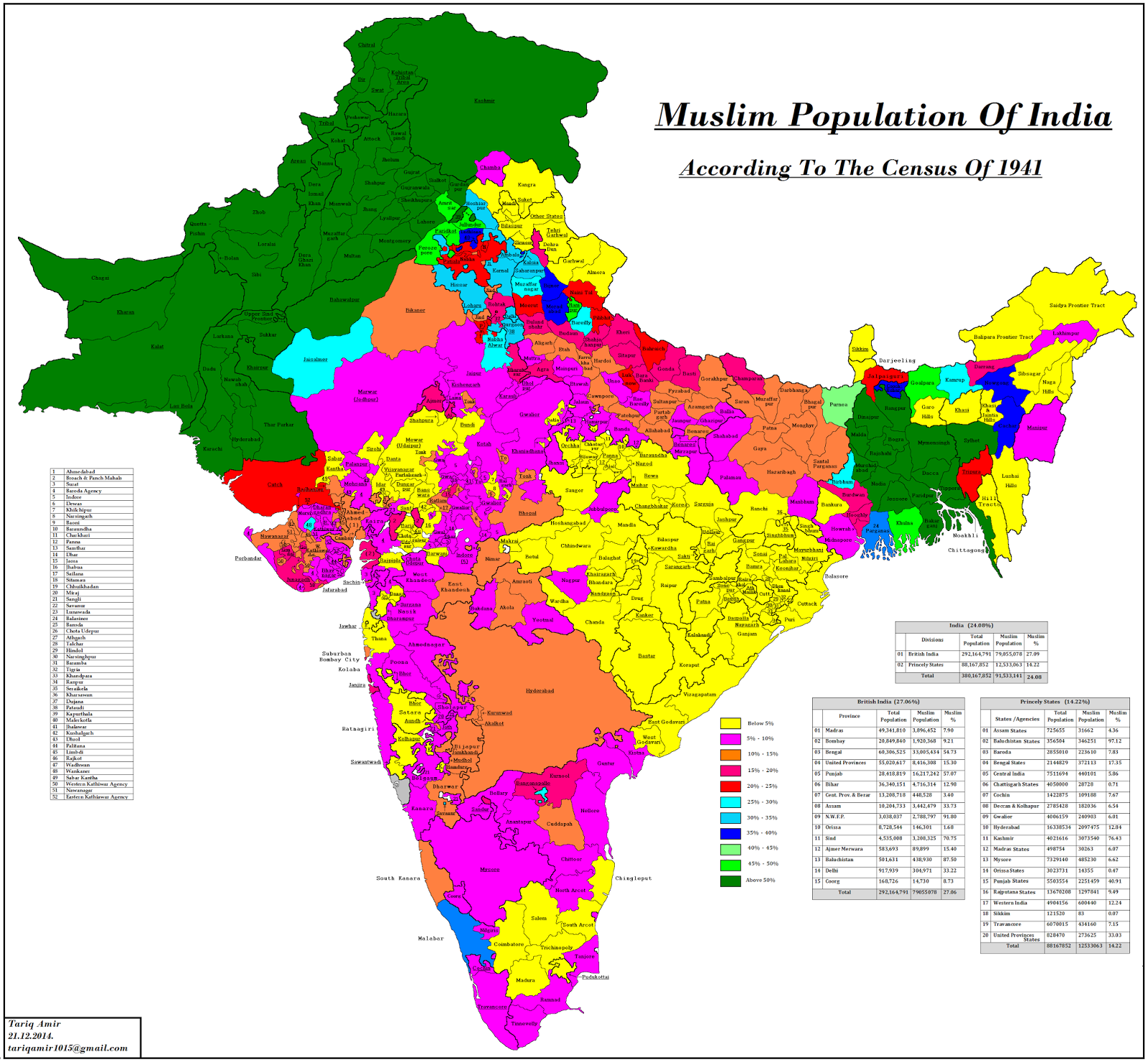
My first piece of information is a map I stumbled upon, which I present below. It presents some very interesting data pertaining to my current topic. The map is based on 1941 census; therefore, it is generally a reliable depiction of the distribution of Muslims in the Indian subcontinent just before independence. As the map shows, the two areas of high percentages (greater than 50 percent) are concentrated in the northwest – Balochistan, NW Frontier Province, Sind, Punjab and Kashmir – and Bengal in the northeast. The percentages in the heartland of Muslim rule – Uttar Pradesh, Bihar, Madhya Pradesh, Gujarat, Maharashtra, Orissa – rarely exceed 30 percent. It is often much lower. This, to me, does not reflect a picture of widespread genocide and forced conversions in the heartland of the empire they ruled for over 500 years. In this context, it must be borne in mind, that unlike Spain, where Muslims reconverted back to Christianity, such was not possible in the present case, since Hinduism did not allow erstwhile Hindus converted to Islam to reconvert back.
Balochistan and NW Frontier Province were British conquests and thus not under the jurisdiction of the Muslim rulers of India for the most part. The situation in Bengal was unique as has been described so well by Professor Richard Eaton (in Rising of Islam and the Bengal Frontier, 1204-1760). He states that major shifts in the Ganges river system took place during the Mughal period, which led to huge areas, mostly in East Bengal becoming available for rice cultivation. There was a consequent burst of activity whereby large movements of population occurred into these areas and gave rise to unprecedented prosperity. This is attested in the Mughal documents of the time. Also significantly, large sections of this newly settled population embraced Islam, inspired by a very vibrant Sufi movement in these areas. I also gather that a vibrant Sufi movement more than any other factor was the primary reason for large scale conversion in Kashmir. The 35-40 percent Muslim population in parts of Assam is also attributed to Sufi movement, since Assam was hardly subject to Muslim domination for any significant period.
Another factor that I find intriguing is that most Hindu practices which are dominant today originated or rather took root during the Muslim Rule, as opposed to predecessor Hindu rule. It is very significant to me that so many of the major preachers of the Bhakti movement flourished during the Muslim rule. There was Ramananda, Sant Kabir, Guru Nanak, Chaitanya Mahaprabhu, Vallabhacharya, Dadu, Mirabai, Surdas, Tukaram. They all left major impacts on us Hindus which are felt to this day. Goswami Tulsidas composed his magnum opus, Ramcharitamanas, a major edifice of religious life of the Hindus in North India, sitting on the banks of Varanasi during Mughal rule. Also, Sridhar Swami wrote his a major commentary on the Bhagavad Gita during the period. Vrindavan was discovered by Sri Chaitanya within the forests in the vicinity of Mathura; he left two of his disciples Goswamis Roop and Sanatan there to spread his Gaudiya Vaishnavism in northern India. The effects of all these are deeply felt in our present day Hindu ethos, perhaps more than those during the so-called Hindu Period prior to the Muslim rule. In my native Bengal, the iconic Durga Puja and Kali Puja in their present forms essentially took shape around the fifteenth or sixteenth centuries. The above is clearly not a picture of an autocratic Muslim hegemony with the majority Hindus suffering in silence, though instances of the cruelty of Muslim rulers including the destruction of numerous Hindu temples and suppression of Hindu life and religious practices on occasion cannot be denied.
That India under the Muslim Rule was far from an economic wasteland is clearly evident from the presence of European merchants in the sixteenth and seventeenth centuries, all trying to gain a foothold in the subcontinent. There were the Portuguese first, followed by the English, the French, the Dutch and even the Danish. Initially, they all came for trade which later gave rise to imperial aspirations culminating in the British conquest of India. And while on India’s economic prosperity during the Muslim Rule, mention should perhaps be made of the famous Moroccan traveler Ibn-Batuta, perhaps the greatest traveler in the pre-modern era. He traveled to most of the areas under Muslim rule at the time from Spain to China. He traveled all over India between 1334 and 1342 and was for a time in the court of the then Sultan in Delhi, Muhammad Tughlaq. In Ibn-Batuta’s travelogues, he describes India as fairly prosperous.
The most convincing answers on this issue should come from literature and songs which predate the British era and have survived to this day. After all, most Indian vernaculars had already taken root by the Muslim period, and literature in vernacular languages was fairly developed at least during the Mughal period. Irfan Habib in his ‘Medieval India, Study of a Civilization’ indicates the presence of significant literary works in Kashmiri, Punjabi, Sindhi, Gujarati, Marathi, Bengali, Assamese and Oriya. In my native Bengal, literary output during the period as has come down to us is really impressive, starting with the Vaishnava Padabalis of Chandidas to the famous Mangal Kavyas, the various biographies of Chaitanya Mahaprabhu, Ramayana by Krittibas, Mahabharata by Kashiramdas – all during the Muslim rule. Incidentally, there is an interesting composition called Maharashtra Purana from the late Muslim period describing vividly the exploits of the Maratha soldiers (Bargis), who regularly pillaged and plundered Bengal – their scary image still lives on in Bengali folklore. A similar composition in Oriya in the eighteenth century, Samarataranga, a poem about war and chivalry, also has the Oriya Maratha conflict as the context. Professor Habib, in his book also includes a chapter ‘Living in Mughal Times’, which relates five narratives, all from sixteenth and seventeenth centuries, describing the life in those times for a cross-section of the population. The narratives include both Hindus and Muslims and cut across various professions. Professor Habib concedes that such available narratives are rather few. And based on these narratives he asserts ‘a freedom in many spheres of life and a general tolerance of religious multiplicity’. But he also observes mutual separateness in many spheres, as general associations beyond one’s religion or caste seem to be largely absent in the narratives. Most importantly, depictions of large scale tyranny and Muslim zealotry, genocide and large scale forced conversions that one would expect, are essentially absent.
All this brings up the question: Where does the pervasive entrenched idea of a tyrannical, despotic, proselytizing Muslim Rule come from? Is this all an orchestrated construct by our English rulers, which subsequent generations have bought into without question? I would like to be enlightened on this.





Comments »
No comments yet.
RSS feed for comments on this post. TrackBack URL
Leave a comment