
The Mask We Wear
Every morning, the streets filled with people. Some walked fast, some stared at their phones, and some smiled as if life were perfect. Among them was a quiet boy named Manan. He watched the world more than he spoke.
To everyone else, life seemed colourful. Social media was filled with expensive cars, perfect vacations, happy families, and endless achievements. Yet, whenever Manan looked into people’s eyes, he saw something different—fear, loneliness, and exhaustion.
One day, he met a wealthy businessman sitting alone in a café. The man owned everything money could buy, yet his hands trembled with anxiety. “I have everything,” he whispered, “except peace.”
On another day, Manan saw a famous influencer laughing while recording a video. The moment the camera stopped, the smile disappeared, replaced by tears. Thousands admired her online, but no one knew she felt invisible in real life.
At college, a brilliant student cried because he had scored one mark less than his friend. Two best friends sat together in silence, each scrolling through endless posts instead of speaking. At home, parents worked day and night to give their children a better future, while the children quietly wished for something simpler—a little more time with them.
Manan began to understand that the greatest battles were not fought on roads or in wars. They were fought inside human minds.
People no longer compared themselves with neighbours; they compared themselves with millions of strangers every day. Success had become louder than kindness. Appearance had become more valuable than character. The fear of being judged had become stronger than the courage to be real.
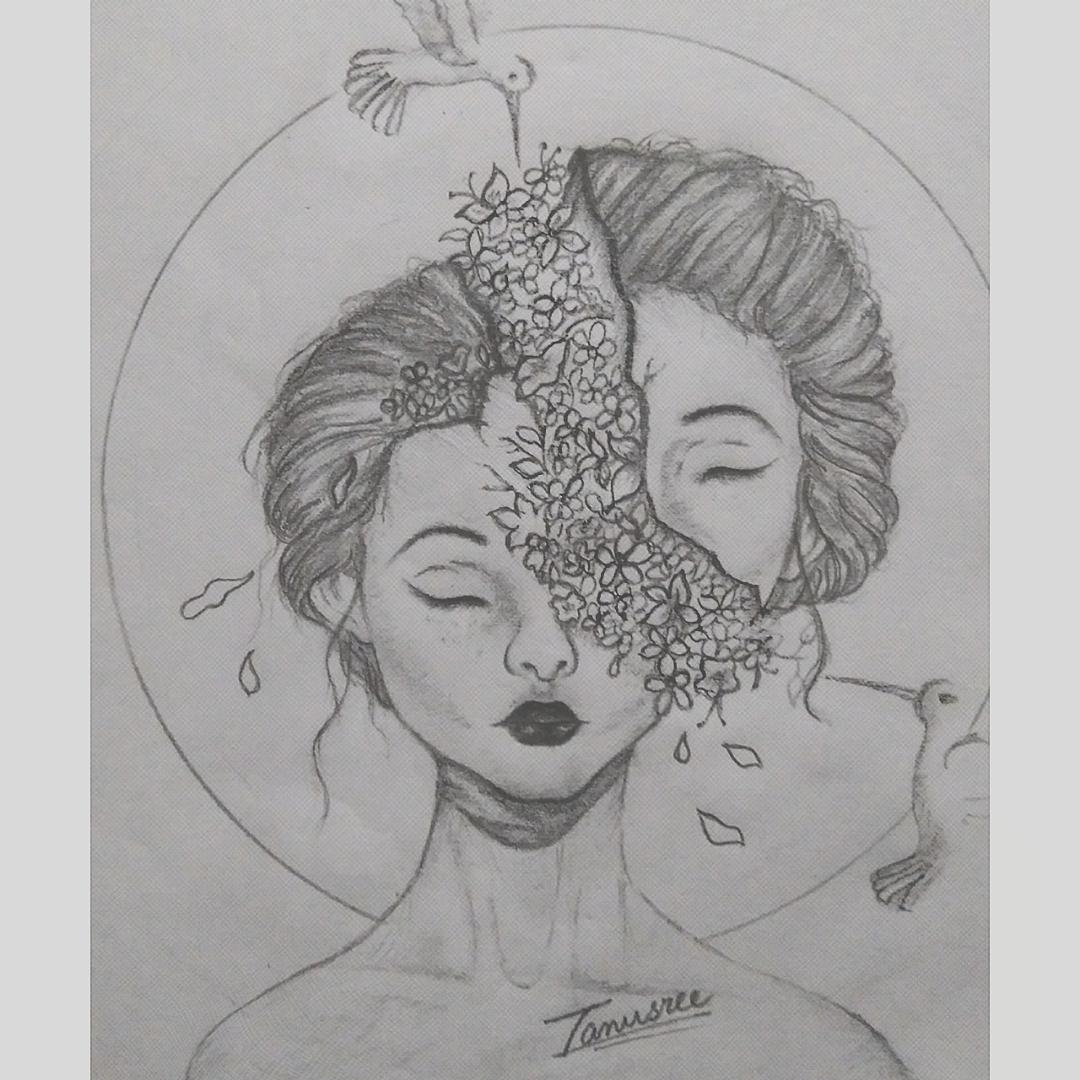
One evening, Manan stood before a mirror. He realized he too had been wearing a mask—the mask of pretending to be strong, pretending not to feel pain, pretending to be someone society wanted him to be.
The next day, he removed that invisible mask. He spoke honestly about his failures, his fears, and his dreams. To his surprise, no one laughed. Instead, others slowly removed their own masks. Conversations replaced comparisons. Listening replaced judging. People discovered that imperfection was not weakness—it was what made them human.
Manan smiled, not because life had become easy, but because people had finally begun to see one another instead of competing with one another.
He realized that humanity was never lost; it had only been hidden behind expectations, comparisons, and the desperate need to appear perfect.
The greatest prison of today’s generation is not built with iron bars. It is built with invisible masks. The day we stop wearing them is the day we truly become free.

Mask We Wear
Author: Arijit Prasad | Posted on: 11th, Sep, 2026



What’s new
-

- বেলাশেষের কবিতা কমল রঞ্জন আচার্য্য


p/1943190224Paperback and e-book formats. Please click below:
https://play.google.com/store/books/details?id=zLrHEAAAQBAJ
Editor’s book:
https://www.archwaypublishing.com/en/bookstore/bookdetails/829905-born-in-heaven
Poems – Poems of Twilight Years by Kamal Acharyya.
Congratulate Prize winner Sreejita Das, niece of Dr. Sibsankar Pal, for her dedication.
Q1 – 2026 contributors (School & College)
Tirthankar Das
Jhelum Chatterjee
Deblina Singha Roy
Q3-2025 contributors (School and College)
Arhon Jana
Molay Konar
Anuska Saha
Ayush Roy
Sagnika Sinha
Deep appreciation for many young contributors in all categories.
Quotes
Funniest Quotes about ageing
“Paradoxically, the idea of living a long life appeals to everyone, but the idea of getting old doesn’t appeal to anyone.”
– *Andy Rooney*
HAPPY AGEING AND GROWING
Day's history
16th October
1934 Mao Zedong & 25,000 troops begin 6,000 miles Long March
1942 Cyclone in the Bay of Bengal kills some 40,000 south of Calcutta India
1951 1st Prime Minister of Pakistan, Liaquat Ali Khan, is assassinated by Said Akbar in Rawalpindi
17th October
1933 Albert Einstein arrives in the US as a refugee from Nazi Germany
1979 Mother Teresa of Calcutta awarded Nobel Peace Prize
18th October
1775 African-American poet Phillis Wheatley freed from slavery
1867 Alaska Purchase: US takes formal possession of Alaska from Russia, having paid $7.2 million
19th October
1910 Subrahmanyan Chandrasekhar, India, astrophysicist (Nobel 1983)
1960 Martin Luther King Jr. arrested in Atlanta sit-in
20th October
1864 US President Abraham Lincoln formally establishes Thanksgiving as a national holiday 1971 West German Chancellor Willy Brandt is awarded Nobel Peace Prize
21st October
1805 Battle of Trafalgar: British Admiral Horatio Nelson defeats combined French and Spanish fleet. Nelson shot and killed during the battle.
1958 1st women in the British House of Lords
22nd October
1721 Tsar Peter the Great becomes “All-Russian Imperator”
1884 International Meridian Conference in Washington, D.C. adopts Greenwich Mean Time (GMT) worldwide, creating 24 international time zones with longitude zero at the Greenwich meridian
1975 Soviet spacecraft Venera 9 soft-lands on Venus, becoming the first lander to return images from the surface of another planet
Day's humor

News
Please click the links below to view:
https://rajyadainik.com/detail/world/21648/
Comments »
No comments yet.
RSS feed for comments on this post. TrackBack URL
Leave a comment