


Graveyard Tour
On Sunday, December 15, 2019, I was fortunate to be part of a walking tour of Calcutta’s graveyards. The tour was organized by Purono Kolkatar Golpo (PKG) a Facebook Group of which I am a member. For me, an amateur history buff (of the layman variety!) it was a godsend. I jumped at the opportunity. I cannot thank the leaders of PKG (Jayanta Sen, Debjani Datta, Swarnil Chattopadhyay, and Dipalika Banerjee Joshi) enough. I am a 52-year resident of the United States, but my native Kolkata never left me. I have been coming back, recently every year after my retirement.
The tour started from the Park Street Cemetary at 9:00 AM. I was somewhat surprised to see where the Cemetery was located and why I had not ventured into it earlier. After all, I was a student at St. Xavier’s School and passed the place countless times. Anyway, the tour started after completion of the initial paraphernalia (a payment of Rs. 150 and an additional Rs. 50 for a camera) with a motley group of about 30 people of all ages and genders. And we had the young and pretty Navpreet Arora as our guide with her delightful lilting English accent.
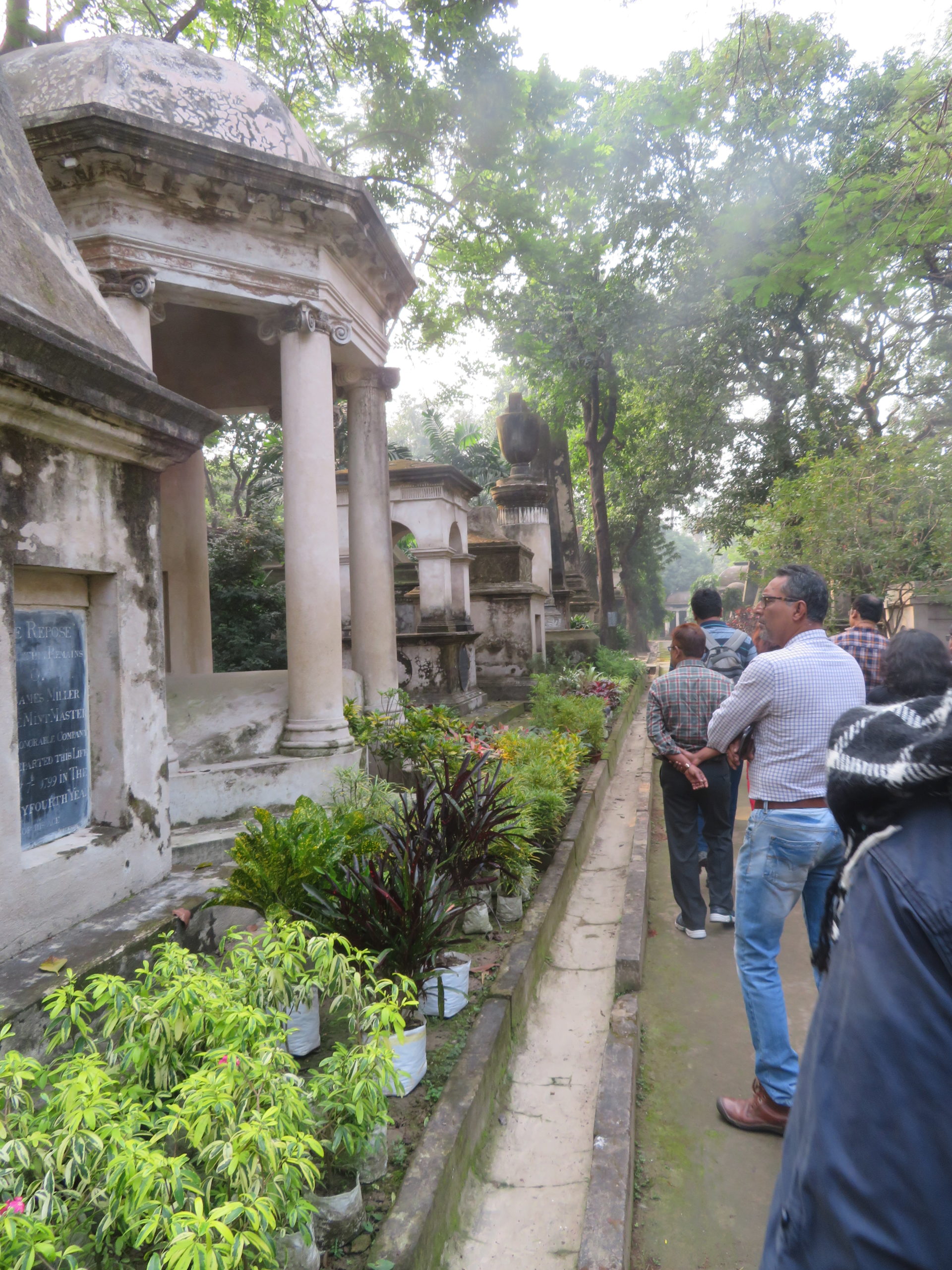
Navpreet kept us engaged with numerous interesting anecdotes and pieces of information as we passed through the pathway between the graves, I could not help remembering my visits to the graves of Prince Dwarkanath Tagore in London and of Raja Rammohan Roy in Bristol. There were uncanny similarities in the architectural styles of the tombs and obelisks and the gray brownstones. I think I posted pictures in PKG. It was somewhat humbling to see many of the graves and tombs in various states of disrepair. Such is life, I guess!
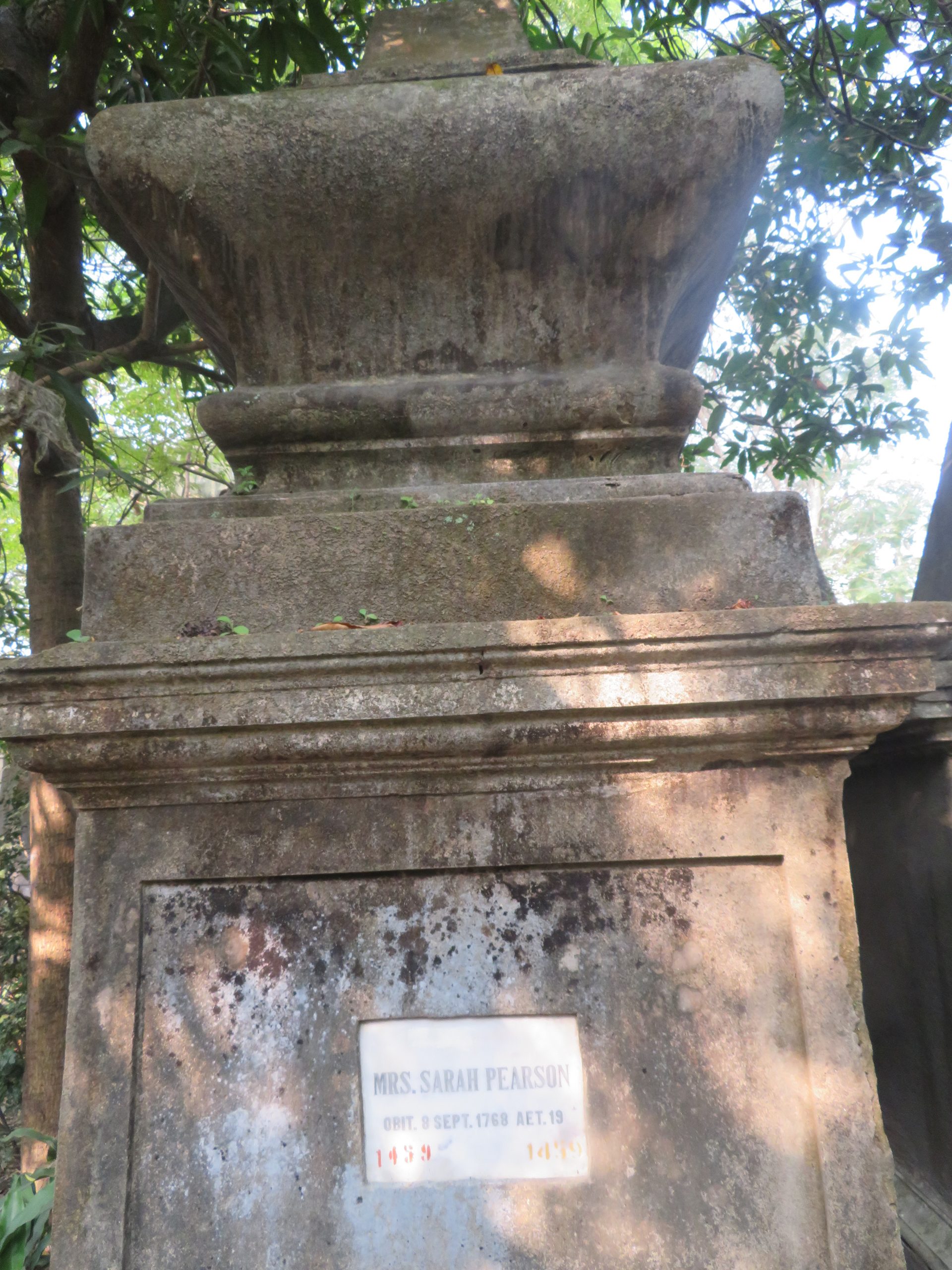
The South Park Street Cemetery was opened in 1767 in marshy land, around a garden house owned by one Mr. Vansittart. It fell into disuse by 1785 and was closed down by 1790. (from Wikipedia). The place is strewn with numerous graves and tombs! They were all of Englishmen, a few women too! A few of the graves belonged to prominent figures, some whose names most of us knew. On the way, Navpreet pointed out the oldest grave, that of Sarah Pearson; she died in 1768.
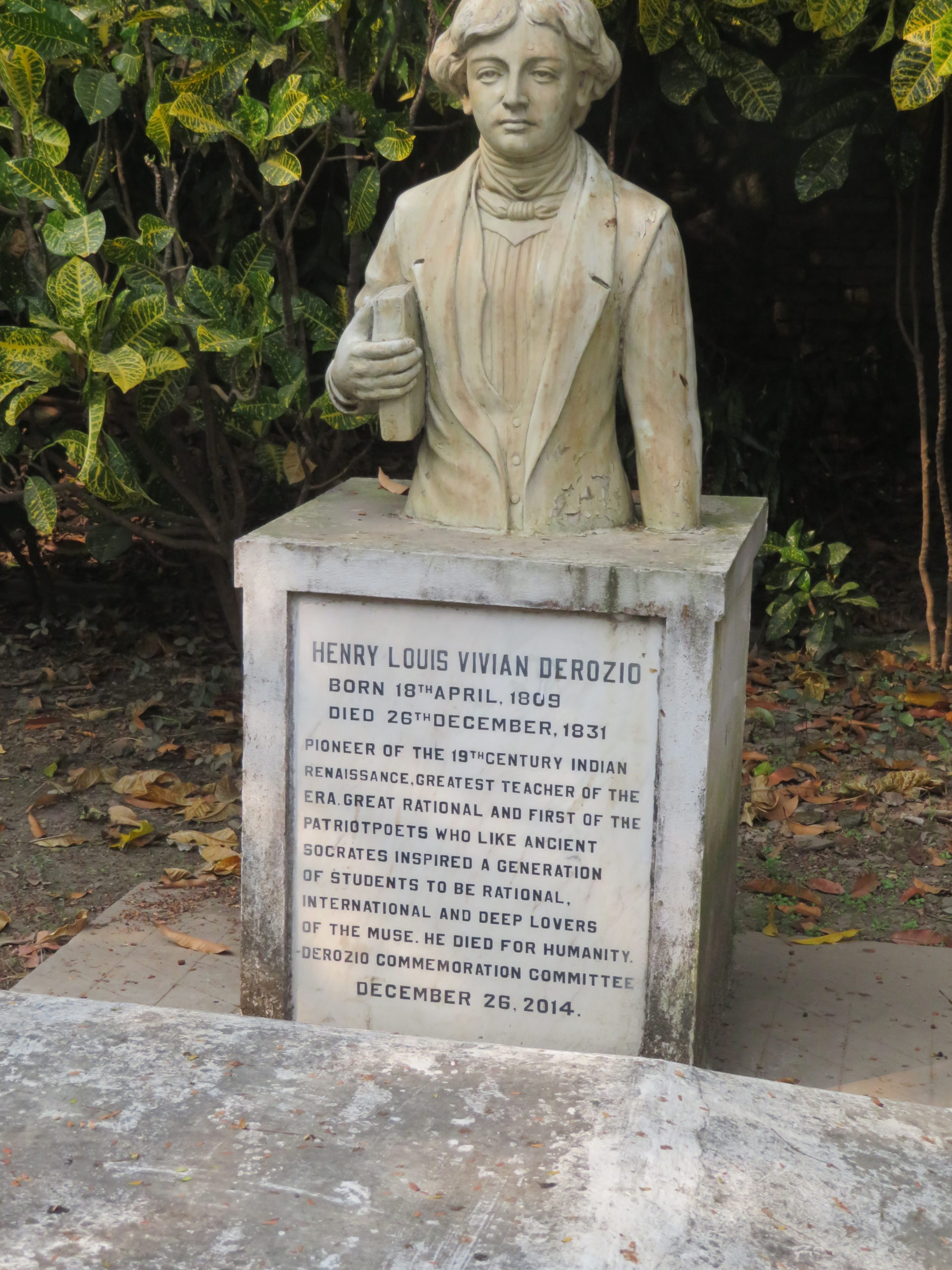
Perhaps the most famous grave was that of Henry Louis Vivian Derozio, a Professor in Hindu College 9later Presidency College). In his brief 22-year life, he was able to influence a number of his students who ushered in much modern thinking and social reforms in later years. They were known as the Young India Movement and included such stalwarts as Ramtanu Lahiri, Ramgopal Ghosh, Krishnamohan Banerjee, Peatychand Mitra, Radhanath Sikdar. Derozio was also a poet of considerable talents and though of mixed European and Indian parentage, left some wonderful patriotic poems.
There is also the grave of Sir William Jones, who founded the Asiatic Society in Calcutta in1784 and started a journal called Asiatick Researches He studied the Vedas with a pandit from Nadia and became a proficient Sanskritist. He made seminal contributions in Indology and linguistics. Perhaps his most lasting contribution is or making and propagating the observation about relationships between the Indo-European languages. He suggested that Sanskrit, Greek and Latin languages had a common root and that indeed they may all be further related, in turn, to Gothic and the Celtic languages, as well as to Persian. This common source came to be known as Proto-Indo-European.
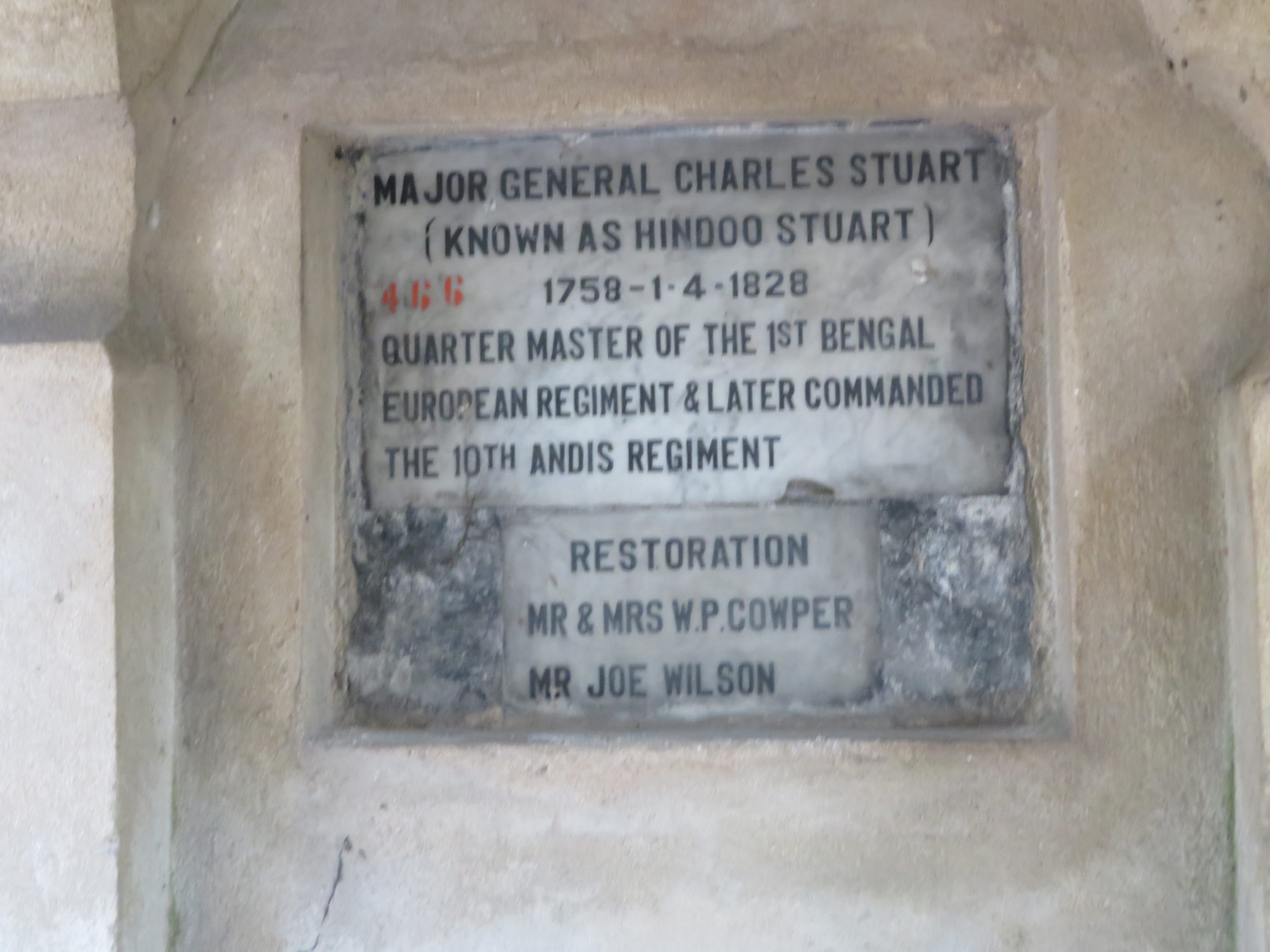
Another prominent grave is that of Charles Stuart. He was an officer in the East India Company Army and is well known for being one of the few British officers to embrace Hindu culture while stationed there, earning the nickname Hindoo Stuart. Stuart enthusiastically embraced Hindu culture and championed the same in his writings and discourse, which earned him the nickname. Stuart took to Hinduism both in its religious aspects and as a way of daily life. He adopted many Hindu customs and routines of daily life, including bathing in the Ganges at Calcutta every morning. His remarkable collection of antiquities forms the basis of the British Museum’s ancient Hindu and Buddhist sculpture collection from the Indian Subcontinent, now known as the Bridge Collection.
Then, there is the interesting grave of Rose Aylmer, on which the immortal poem by her lover, Walter George Landor after her death is inscribed.
Ah, what avails the sceptered race,
Ah, what the form divine!
What, every virtue, every grace!
Rose Aylmer, all were thine.
Rose Aylmer, whom these wakeful eyes
May weep but never see
A night of memories and sighs
I consecrate to thee.
Apparently she was shipped off to India at seventeen to separate her from her lover and died of cholera two years. Some locals, however, believed she died of overconsumption of pineapples, a common belief those days of the cause of cholera.
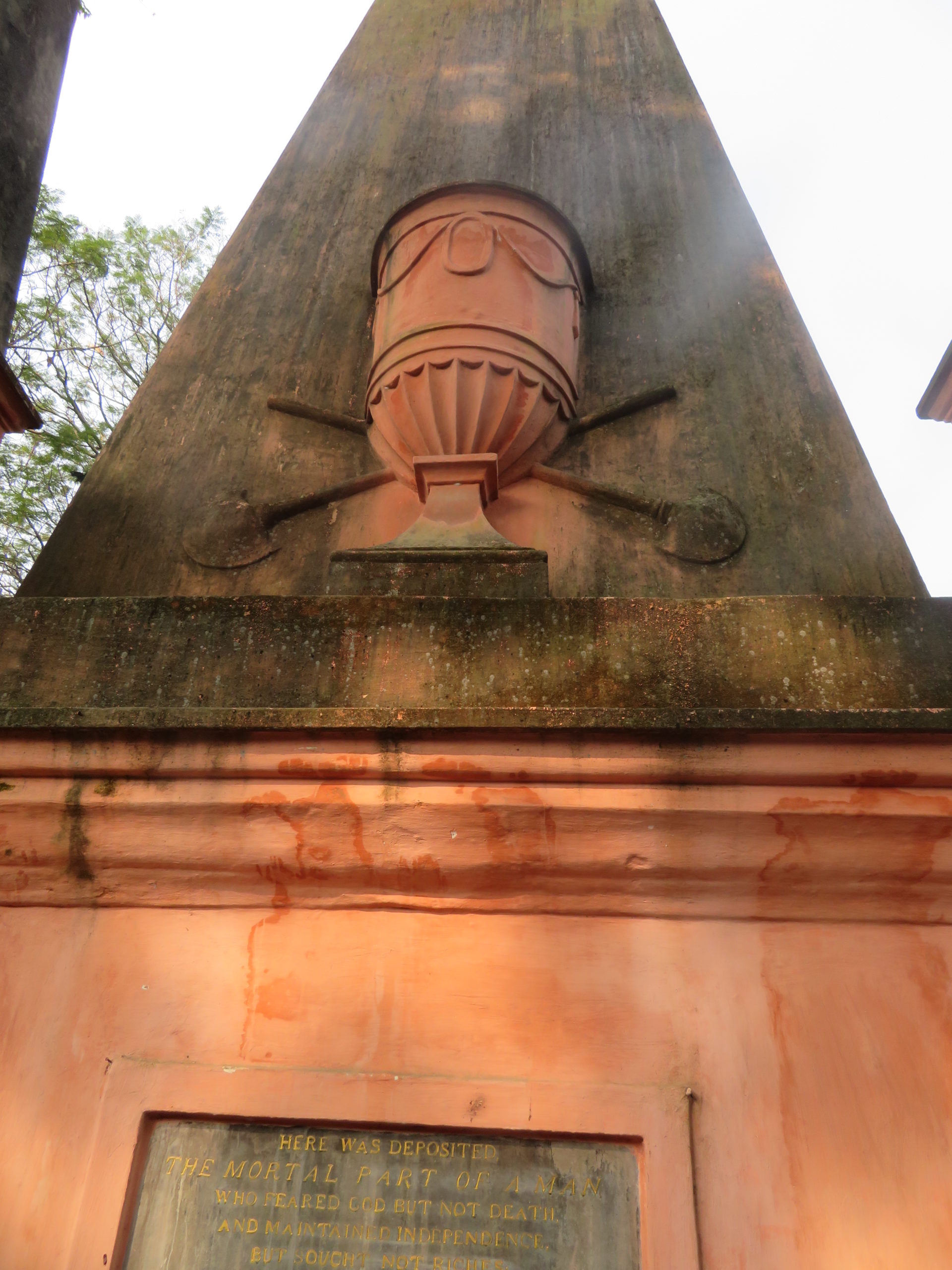
As with many old cemeteries around the world, the South Park Street Cemetery also holds its share of haunted graves. A small, pyramid-shaped structure deep in the undergrowth is called the “bleeding tomb.” It is rumored that the tomb oozes a blood-like substance during monsoons. This forgotten memorial belongs to the Dennison family, all of whom died within weeks of one another. The reason is not recorded, and will probably never be known.
There is also the grave of Walter Savage Landor Dickens, the second son of the novelist Charles Dickens. It was originally located in the Bhawanipore Cemetery and was moved here by the efforts of Jadavpur University in I987. There was also a grave of the son of Sir Elijah Impey the famous judge of the Calcutta High Court. There was also the tomb of Mr. Barwell, a friend of Warren Hastings.
Navpreet related to us the interesting episode reflecting the life of the Englishmen in those days. The harsh summers took the lives of many young men. To celebrate the passage of the summer, the survivors celebrated with Monsoon Balls in many of the English Clubs. The tradition still seems to live on in some of the clubs, though not quite for the same reasons. The tour ended at about 10:30 AM. We were all reasonably tired. We were treated with potato curry and puris. It was a welcome relief. There were some souvenirs being sold but they sold out by the time I got to it.
And there was more. We crossed the Lower Circular Road (now AJC Bose Roadans turns right on Park Street into the Scottish Cemetery. Navpreet continued with us as our guide. After entering, she explained that in some ways it was the Scotsmen that built Calcutta (now Kolkata). She also said that the Scotsmen were poorer and so could not afford the South Park Street Cemetery. I suggested that there may be another reason too: the Scotsmen were Presbyterian whereas the Englishmen were Anglicans. She seemed to agree. Navpreet also noted that the cemetery was subjected to severe vandalism by the locals. Later, an understanding was reached after which the locals helped preserve it.
I was excited to find the tomb of Lal Behari Dey amongst the Scotsmen. He had converted to Christianity while a student at the General Assembly Institution (later Scottish Church College. He was later a Principal at Behrampore Collegiate School and later taught in various institutions including Hoogli Mohsin College. He was made a Fellow of the University of Calcutta in 1877. Of particular note is the fact that he received compliments from none other than Charles Darwin in 1881 for his novel, Govinda Samanta. Another grave of note was that of Reverend Thomas Jones, founder of the Khasi alphabets and literature.
The tour ended before lunch. It was a day very well spent, for which I cannot thank the four leaders of Purono Kolkatar Golpo enough:





Comments »
No comments yet.
RSS feed for comments on this post. TrackBack URL
Leave a comment