




Before we go further into quantum mechanics, let us concentrate on an atom. Understanding the elementary constituent of matter is most important for quantum physics. We will stick with the concept, models and no mathematics. I have said before I am lucky to spend my retirement life to read articles from many scientific sites. Google and Wikipedia have enormous material on this subject.
There was a constant search for smaller particles in the mind of ancient philosophers and scientists even before many centuries of BC. Today scientists found that a subatomic particle can be decayed and create other particles. It sees particle as radiation.
In the evolution of finding the smaller and smaller particle, the idea of molecules and atoms brought modern physics to a different level. Particle physics gave a quantum leap to modern physics by finding elementary particles and their behavior.
We now know that atoms are made up of three particles: protons, neutrons, and electrons — which are composed of even smaller particles such as quarks.
Theoretical physicists and scientists agree that after the Big Bang about 14 billion years ago the universe was extremely hot and dense, and it took 380,000 years to cool down to form quarks and electrons. Quarks came together to form protons and neutrons, and these particles combined into nuclei.
As universe cool down further hydrogen and helium were created. These are the earliest atoms in the universe. The stars were born from the clouds of gas (molecules, atoms) due to inherent interaction (force) and gravity.
Molecules are held together by the chemical bond with two or more atoms. In our discussion, we will mostly concentrate on the atomic, subatomic structure. This is the branch of nuclear physics.
Following picture clearly depicts the atomic model. We have seen this model from school or college. It is the starting point for nuclear physics. Throughout the last two century, many physicists and scientists with their dedication and lab experiments gave humanity with quantum theory. It appears that we are very close to the end of knowledge. I am sure this will not be true.

Courtesy of Google
Quarks came together to form protons and neutrons, and these particles combined into nuclei.
The cloud of negatively-charged electrons bound together by electrostatic force.
Protons and neutrons are bound together to form a nucleus by the nuclear force.
Physicists are in agreement that electrons and quarks are the smallest building blocks of matter.
Without particle accelerator, scientists could not find these subatomic particles.
So fundamental particles electrons and quarks are made up of everything, yes, including you and us.
Scientists are breaking down the particles further and further. We now know that there are six types of quarks. Neutrons and protons are made up of quarks, which are held together by Gluons.
A further look inside the proton and neutron reveals that –
A proton is made up of two Up quarks and a Down quark.
A neutron is made up of two Down quarks and an Up quark.
A family of lighter particles called Pions that are made from pairs of quarks.
The fifth and sixth quarks used to call truth and beauty even by the physicists
These composite particles are called Upsilon.
Experimentally quarks are to be found within hadrons, such as baryons (protons and neutrons are examples) and mesons. We will discuss later in details of those subatomic particles.
Scientists found there are 4 fundamental forces of nature as noted below-
Electromagnetism
Gravitation
Strong interaction
Weak interaction
Everything in the universe is bound by these forces.
A great many scientists and physicists explain this entire interaction phenomenon by very complex mathematics.
Particle decay plays a big role for quarks; heavier quarks rapidly change into up and down quarks.
Scientists are in agreement that there are Antiparticles, known as an antiquark, with its properties of equal magnitude but opposite sign of quark.
Quarks and antiquark have various intrinsic properties, such as electric charge, mass, color charge, and spin.
Evolution of understanding ATOM
Ancient Concept
1. Understanding of atomic concept started by Sanatan dharma during very ancient time. However there was no written record, the concept was passed down by ancient people.
2. Indian sage and philosopher, known as Acharya Kanad (Kashyap) in 600 BC is the most prominent for this atomic concept.
3. Also, we must recognize many other Indian and Greek philosophers namely Democritus. Aristotle 300BC.
Modern Concept and Models
4. Dalton’s Solid Sphere Model was the first atomic model in the early 19th century;
5. Thompson discovered the electron and modified the model further.
6. Ernest Rutherford discovered the nucleus. He is the pioneer of the modern Nuclear Model in 1911.
7. Neils Bohr described the similarity of an atom with the Solar system model in 1913. This model explains how electrons travel in separate orbits around the nucleus.
8. Rutherford came up with the Proton Model in 1918. Bohr’s model is the most popular model.
Current Model
9. Werner Heisenberg came up with the idea of the electron cloud model in 1927 as opposed to separate fixed orbit. This electron cloud model is based on quantum mechanics. James Chadwick discovered neutrons in 1932.
Kanad’s conception of Anu (the atom):
He called the indivisible matter as Parmanu, or anu (atom).
He said one Parmanu combine with another create a dwinuka (molecule), Very concept of atomic bonding.
Scientists and Physicists are finding more and more subatomic particles with the aid of powerful particle accelerator.
Carbon atom model
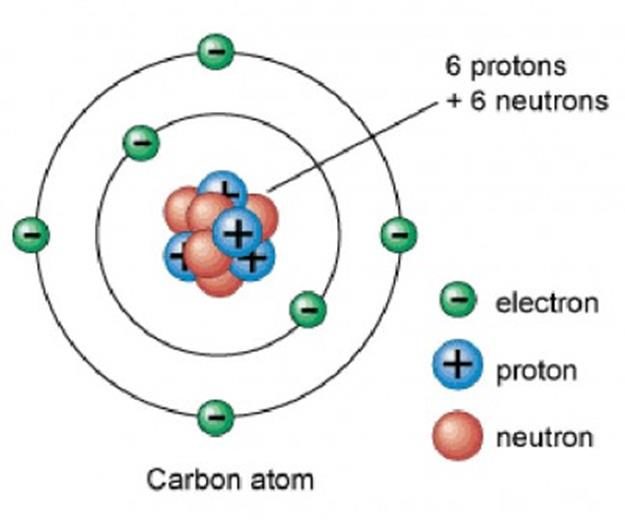
Courtesy of Google
We will discuss more about particle physics in future articles. Just to complete this article I would like to mention a few notes;
Elementary particle composed of quarks and leptons. There are six types of leptons.
Leptons fall in 2 categories (charged, neutral)
One of the leptons is an electron which we are very familiar. We will discuss others in our future articles.
All the sub-particles have intrinsic properties like spin, mass, charge, and interactions.
These properties will be the subject of our discussion in the future.
To be continued……







Comments »
No comments yet.
RSS feed for comments on this post. TrackBack URL
Leave a comment